
How to Use a Humane Trap to Bring a Lost Cat Home
Last updated: May 2026· 15 min read
It’s 2:17 a.m. Your phone buzzes. The motion alert pulls you out of sleep and you grab it, squinting at the grainy camera feed. There she is. Your cat. Thin, wide-eyed, crouched at the edge of the driveway like she’s listening for something only she can hear.
You throw on shoes and go outside. She sees you. She runs.
You stand there in the dark feeling rejected, maybe even a little betrayed. But she didn’t run because she doesn’t know you. She ran because something happened to her out there, and right now, fear is running the show. Cats who’ve been loose for even a few days can drop into what behaviorists call “survival mode,” a physiological state where the instinct to flee overrides years of trust. She’s not your indoor cat anymore. She’s a scared animal trying to stay alive.
That’s why calling her name isn’t working. And why a trap will.
This guide will walk you through exactly what to do, from setting up your first trap tonight to getting her safely inside once she’s caught. You don’t need experience. You need the right information and a few supplies.
What a Humane Trap Does (and Doesn’t Do)
A humane box trap is a wire cage, usually 30–36 inches long, with a spring-loaded front door and a “trip plate” in the middle of the floor. When a cat walks in to reach the bait at the back, her weight on the plate triggers the front door to close and lock behind her. She’s contained, uninjured, and waiting for you.
What it doesn’t do: call her in, speed up the process, or guarantee a fast result. Think of it as infrastructure, not magic. A trap creates the opportunity to catch a cat who won’t come to you. Whether and when that opportunity works depends on placement, bait, hunger, and patience.
It also doesn’t harm her. Humane traps are designed to contain, not injure. The biggest risk to a trapped cat is heat, cold, stress, and being left unmonitored. All of which are in your control.
When Trapping Makes Sense
Trapping is the right move when:
- Your cat won’t approach you even though you’ve spotted her nearby
- She’s been missing more than 48 hours (survival mode typically sets in quickly)
- You’ve tried calling, sitting outside, and leaving food, and nothing is working
- She’s been seen returning to a specific spot, even once
Trapping is especially effective for cats who’ve gone into hiding close to home. Lost cats, unlike lost dogs, usually don’t travel far. Research consistently shows they stay within a few blocks (sometimes within a single yard) and move mostly at night. If you’ve had even one sighting, you’re probably closer than you think.
What You’ll Need to Get Started Tonight
You don’t need to order anything exotic. Here’s the short list:
The trap itself. A standard humane box trap in the 30–36 inch range works well for cats. Tomahawk, Tru-Catch, and Havahart all make widely available models. If you can’t buy one tonight, many animal shelters, rescue groups, and animal control offices loan or rent traps for exactly this situation. Call first thing in the morning, or check if a local TNR (Trap-Neuter-Return) group in your area has a trap bank.
Bait. More on this below, but canned tuna, sardines, mackerel, or your cat’s own food are all good starting points. Smelly and wet is the goal.
A cover. An old sheet, towel, or piece of cardboard. You’ll use this to cover the trap once she’s caught, which dramatically reduces her stress.
Something to protect the vehicle. A plastic drop cloth or garbage bag for the car floor when you transport her.
A flashlight or headlamp. Especially if you’re checking traps at night. A headlamp keeps both hands free, which matters when you’re moving a trap with a frightened cat inside.
The Single Most Important Factor: Hunger
Before anything else, understand this: hunger is the mechanism that makes trapping work.
Feral cat experts at Neighborhood Cats, one of the leading TNR organizations in the country, put it plainly: a cat who isn’t hungry may not enter a trap no matter how good the bait smells. If your cat has access to any other food source (a neighbor feeding her, a bird feeder she’s raiding, garbage cans) the trap becomes optional for her.
If it’s safe and feasible, stop putting food out at least 18–24 hours before you set the trap. This is the step most owners skip. It’s also the step that makes the biggest difference.
This rule applies to indoor/outdoor cats and strays who’ve been loose for a while. If you have a neighbor feeding community cats in the area, a polite heads-up that you’re trying to recover your lost pet goes a long way.
Where to Place the Trap
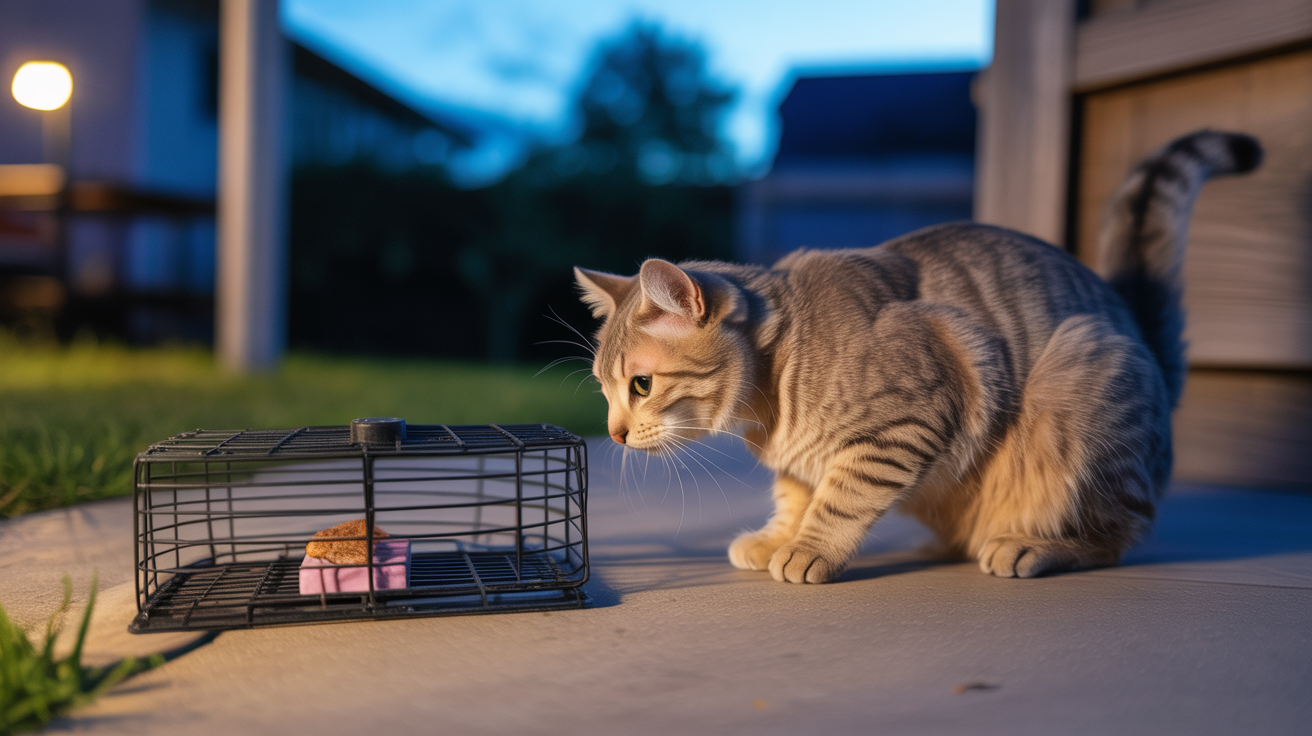
Location is almost as important as hunger. A trap sitting in the middle of an open yard, away from anything familiar, looks like exactly what it is. A strange metal box. Most cats will give it a wide berth.
Instead, place the trap:
Along a wall, fence, or structure. Cats are “thigmotaxic,” meaning they move along edges rather than across open spaces. A trap positioned flush against a fence line, the side of a building, a car bumper, or a hedge fits into how they naturally move. It stops looking like a threat and starts looking like a tunnel.
Near where she was last seen. If you have a camera or a neighbor report, anchor your placement there. If she’s shown up at a specific corner, feeding spot, or outbuilding more than once, that’s your primary site.
On level ground. A trap that rocks or tips when she steps on the trip plate may spook her before the door closes. Check it before you walk away.
Away from direct sunlight if it’s warm. Wet bait dries out and loses its smell fast. If you can’t avoid sun exposure, partially drape the back of the trap with a sheet held down by a rock to shade the bait. Just make sure both the front and rear openings stay uncovered so she can see all the way through.
Don’t place the trap directly beside another trap. Give each one a few feet of space.
What Bait to Use
There’s no single perfect bait, which is why experienced trappers bring two kinds. The goal is strong scent, something that carries on the air and pulls her in from a distance.
Reliable standbys: cheap tuna cat food, canned mackerel, canned sardines. These work because the smell is intense and travels. Human-grade tuna also works well.
Backup options: cooked chicken, roast beef, fast-food hamburger. Some cats who dislike fish respond to meat.
The trail trick: Crumble a few Pounce-style cat treats and make a loose trail starting a few feet from the front of the trap, leading inside to the main bait. You can also drizzle a little tuna juice along the same path. Don’t use so much that she fills up before she reaches the trip plate.
Catnip spray: Highly concentrated catnip spray (not dried flakes, which blow away) can be applied directly to the trip plate. Some cats find it irresistible and it’s worth trying, especially for cats who haven’t responded to food alone.
Put the bait on a small paper plate or plastic plate and place it at the very back of the trap, right up against the rear door. The further back the bait sits, the further into the trap she’ll have to go, and the more likely the trip plate is to engage before she can back out.
How to Condition Her to Return to the Trap Area
If you’ve had sightings, you have a real edge: she already has a home range, and she’ll keep coming back to familiar spots.
For at least a few days before you set a live trap, leave unbaited food at the same spot, at the same time each day. This trains her to expect food there and to lower her guard. When the actual trap goes out, she’s already been visiting that location. The trap is just a new element at a familiar spot.
If you have her scent (a worn shirt, her bedding, a litter box with a bit of used litter), place it near the trap entrance. This can help a frightened cat connect the trap to something familiar. Some owners also leave a piece of their own worn clothing near the trap.
How to Monitor the Trap Without Spooking Her
This is the part most people get wrong.
Once the trap is set and in position, leave the area. Standing nearby watching is one of the most effective ways to prevent a cat from going in. Cats are acutely tuned to human attention. If you’re staring at her, even from ten feet away, she knows it, and it’s often enough to make her turn around.
Go inside. Sit in your car. Watch from a window. Check a camera feed on your phone. Just don’t hover.
That said, you cannot set a trap and go to sleep. Traps should never be left fully unattended. Once a cat is inside, she’s completely vulnerable to other animals, weather, and stress. Check every 30 minutes if possible, and don’t let more than two hours pass without checking.
If you’re trapping overnight:
- Check at least once every two hours
- Have a plan for where she’ll go as soon as she’s caught — ideally a quiet, warm room inside your home
- Keep your phone nearby with the volume on
In cold weather, have a blanket ready to drape over the trap immediately after she’s caught, leaving airflow at the ends. Move her to a warm space as fast as possible.
What to Do the Moment the Trap Closes
The second you know she’s in the trap, go. Calmly. Don’t run. Fast movement and loud sounds will spike her fear.
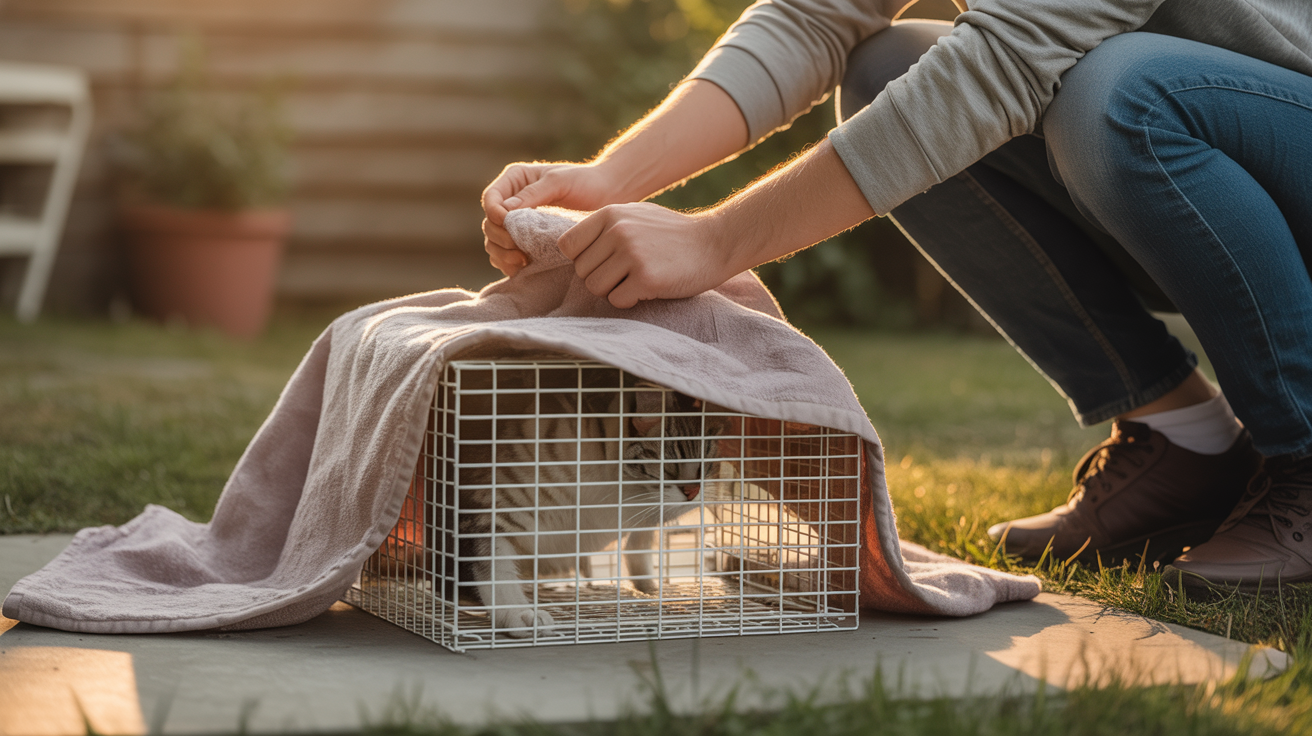
- Cover the trap immediately. Drop a sheet, towel, or jacket over it. Dark, enclosed spaces calm cats. She’ll still be panicked, but the visual shield helps.
- Don’t try to open the trap or reach in. Even if she’s your cat and you’ve had her for years, she may scratch or bite right now. She doesn’t know she’s safe yet. Let her settle.
- Move her to a quiet room. Carry the covered trap carefully, keeping it level. Put her somewhere warm and quiet: a bathroom, a bedroom, anywhere away from noise, other pets, and commotion.
- Give her time. Before you open anything, let her sit in the quiet room for 30–60 minutes. Talk to her softly through the cover. Offer a little food through the wire if she seems curious. Let her hear your voice and associate it with calm.
- When you do open the trap, do it in a closed room. A panicked cat can bolt faster than you can react. If she races out of the trap, you want her contained to a single room, not back outside.
Common Mistakes to Avoid
Putting food out right up until you set the trap. If she’s been eating regularly, she has no reason to risk the trap. Withhold food for at least 18–24 hours first.
Leaving the trap in an open, exposed location. She’s more likely to investigate something that looks like part of her environment than something sitting alone in the middle of a lawn.
Checking too often. Every time you walk into the area, you reset the clock. She may have been approaching when you showed up.
Giving up after one night. Trapping can take several nights. Some cats take a week. If you’re seeing signs she’s still in the area, keep going.
Baiting too lightly. Put a real, generous portion of food at the back of the trap. A tiny amount won’t carry enough smell to draw her in from a distance, and she may reach the bait through the wire from outside without ever going in.
Leaving the trap unmonitored. This is a safety issue. A trapped cat left outside in heat, cold, or rain can die. Never set a trap you can’t actively check.
Wildlife, Weather, and Neighborhood Pets
Humane traps don’t know the difference between your cat and a raccoon, skunk, or opossum.
If you catch wildlife:
- Keep yourself calm and low
- Approach slowly, cover the trap fully with a sheet, and let the animal settle
- For raccoons and opossums, take the trap to a nearby wooded or brushy area, open the rear door from a safe distance, and step back
- For skunks: move very slowly and quietly. Cover the trap completely before lifting. Skunks spray when startled, but a covered trap and calm movements greatly reduce the risk. Open the rear door from a distance and give the skunk as much time as it needs
If you catch a neighbor’s cat, check the ear (a notched or tipped left ear indicates a spayed/neutered community cat who belongs outside). If it’s an intact pet, contact the owner or your local animal control.
In rain: slip the trap into a large garbage or contractor bag, cut away the material covering both doors, and use duct tape to secure the bag in place. This keeps the bait from getting soaked and her from getting wet while she’s waiting.
Indoor-Only vs. Indoor/Outdoor Cats: What Changes
Indoor-only cats who’ve escaped are typically more disoriented and more likely to be hiding very close to home. They haven’t built up outdoor survival instincts, which paradoxically makes them harder to call back. They’re too frightened to respond to familiar voices. Trapping is often the fastest path back for them. Prioritize placing the trap right outside your door or near wherever she was last seen.
Indoor/outdoor cats have more environmental confidence but also more options. They may be ranging further and returning less predictably. They’re often faster to respond to food, since they know the outdoor landscape and aren’t paralyzed by fear. Set traps at their known hangouts.
Community or semi-feral cats who you’ve been feeding are the most comfortable with outdoor life and the hardest to bring in without a trap. These cats require more patience and usually benefit from pre-conditioning: feeding at a consistent time and place for at least a week before the trap goes out.
Frequently Asked Questions
- How long does trapping usually take?
- There’s no fixed timeline. Some cats walk in on the first night. Others take a week or longer. The single biggest variable is hunger, followed by trap placement. If she’s been sighted nearby and the trap is in the right location, most owners catch their cat within a few nights.
- Should I cover the trap?
- You don’t need to cover it before she’s caught. Most cats will go in either way, and covers tend to blow around. What matters more is placement along a wall or structure. Once she’s inside, cover it immediately.
- Can she get hurt in a humane trap?
- Not from the trap itself, if it’s the right size (30–36 inches long) and has a proper rear door. The risks come from heat, cold, and being left too long without checking. Monitor closely.
- What if she avoids the trap?
- Try a different bait, move the trap to a slightly different position along the same wall, or extend the trip plate with a piece of cardboard taped to the middle (this helps cats who step or lean over a small trip plate to reach the bait without triggering it). Give the trap a few days in the same location before moving it. She may be circling it and getting more comfortable each night.
- Should I use a trap if I’ve already seen her nearby?
- Yes, especially if approaching hasn’t worked. A sighting that close is excellent news. Set the trap at or near that exact location.
- What do I do after the trap closes?
- Cover it, move her to a quiet indoor space, and give her time before opening it. Let her hear your voice from outside the covered trap for at least 30 minutes. Open the trap only inside a fully closed room.
A Note on Patience
Recovery stories almost always involve one or more nights where nothing happened, followed by the night it did. Your cat is out there trying to solve a problem she doesn’t have the vocabulary to explain. The trap gives her a way home that doesn’t require her to overcome fear on her own.
Keep the food withheld. Keep checking the trap. Keep the camera running. Most cats come back.